

If you’re looking for the best small towns in Italy to visit, continue reading!
Italy is known for its beautiful towns, each with its own charm and unique atmosphere.
From rural villages to coastal towns, Italy has a lot to offer besides big cities such as Rome and Milan.
Even the lesser-known towns, the tiny hamlets, and the most remote places along this boot-shaped peninsula give travelers an unforgettable experience.
Each small village is unique. With distinctive monuments, whether churches, castles, or palaces, and with typical dishes that you don’t find in villages even a short distance away.
This is also why Italians tend to travel more in Italy than abroad.
As for me, I was born and raised in Rome, and started exploring the villages in the countryside around Rome at a young age.
I have by now visited countless beautiful small towns all over the country and I want to use this article to share the prettiest Italian towns and small villages that are well worth visiting.
25 of The Best Small Towns in Italy to Visit
1. Calcata Vecchia
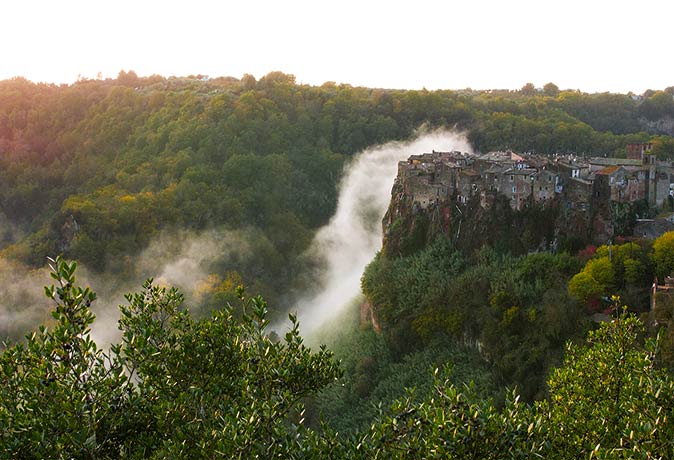
Calcata is a village in northern Lazio located about halfway between Rome and Viterbo.
Calcata’s old town, Calcata Vecchia, is perched on a scenic cliff that stands out in the middle of the lush Treja Valley.
The landscape surrounding the village features canyons and boulders and a valley in the middle of which a river flows.
The road to Calcata crosses this valley covered with dense forests. In these forests you can find the vestiges of the Falisci, the ancient people who inhabited this region several centuries before the Romans.
When I drove to Calcata for the first time I remember thinking: is this Italy? I had never seen this kind of landscape in Italy.
That turned out to be the first of an indefinite number of visits to Calcata, as I ended up starting a family with a man who grew up in Calcata.
The phenomenon that made this hilltop village so interesting has its roots in the 1960s. It was in this era that the inhabitants of Calcata, mostly peasants, abandoned the historic center and moved into newer houses.
At the same time, artists and unconventional people from around the world began to move to Calcata, buying up the old stone houses and opening their studios.
The artists saw Calcata as the perfect place to make art and go against the grain, breaking away from the industrialization that was taking over the world.
Those artists and their descendants are still connected to Calcata. This is why Calcata is now known as the artists’ village near Rome.
Visiting this beautiful Italian village also means coming into contact with many eccentric and brilliant personalities.
The architecture of Calcata Vecchia dates back to the Middle Ages. Still preserved are the only ancient entrance portal to the town, a section of the defensive walls, and the watchtower, which is part of the 11th-century Anguillara Palace.
Local travelers come here mostly to have lunch in the picturesque village. The small restaurants offer local specialties such as homemade pasta, porcini mushrooms, and pecorino cheese, made into original dishes.
2. Polignano a Mare
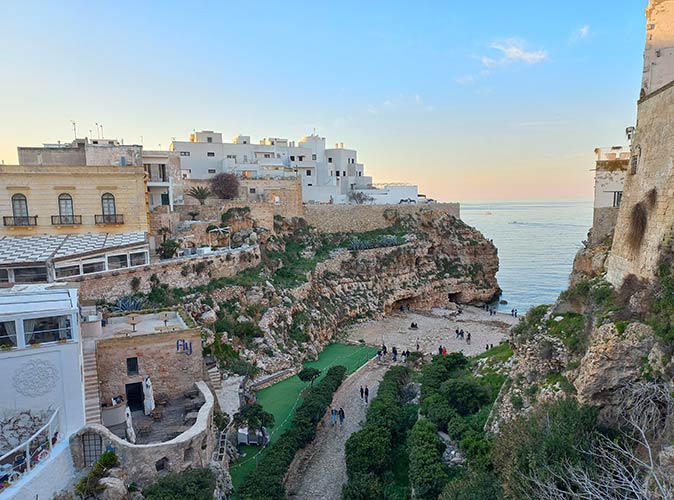
Polignano a Mare in Puglia is a beautiful Italian town famous for the beauty of its historic center and spectacular views of the Italian Adriatic coast.
The town is known for its many sea caves. One of them is the famous Grotta Palazzese, a natural cave overlooking the sea, home to a beautiful Michelin-starred restaurant.
Polignano a Mare has such a unique landscape because it is built on a large limestone rock that plunges into the sea.
There are other similar villages on the Gargano Riviera in Puglia, such as Vieste, but Polignano is the most fascinating.
The historic center of Polignano a Mare is characterized by small white houses with colorful shutters and narrow alleys. Wander around the alleys to soak up the vibe and stop at the different lookout points for panoramic views of the sea.
The main historical landmarks in Polignano include the Church of Santa Maria Assunta, the Pino Pascali Museum of Contemporary Art, and the Lama Monachile Beach, also known as “Cala Porto.”
A tradition in this small town is cliff diving. For decades, Polignano locals have enjoyed diving into the crystal-clear sea waters launching themselves from a high rock overlooking the old town, known as the “Ponticello.”
It gained international recognition when Red Bull chose it as its location for their Cliff Diving World Series in 2022.
Also Read: Visiting Puglia – Things to Know and What Are The Best Places to Stay in Puglia?
3. Castiglione di Sicilia
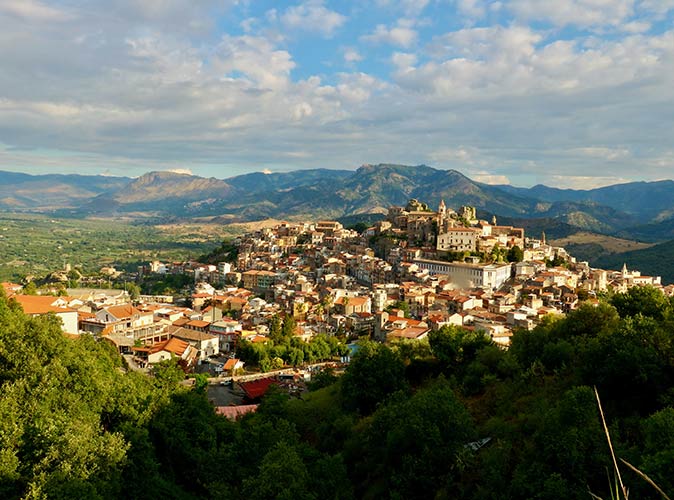
Castiglione di Sicilia is a medieval village located in the eastern part of Sicily, in the heart of Mount Etna Park.
The village stretches over a hill offering breathtaking views of the Ionian Coast, which you can reach within a short drive.
Dotted with narrow stone streets, old houses, and noble palaces, this village is a real jewel of medieval architecture.
The Church of Sant’Antonio Abate, located on the main square, is a clear testimony to the importance of Baroque architecture in Sicily.
Castiglione is a beautiful off-the-beaten-path town that you can use as a base for exploring the east coast of Sicily.
From here, you can plan a day tour to Mount Etna and visit other destinations in the area, such as Taormina and Naxos Gardens.
Also Read: The Most Beautiful Places in Sicily to Visit
A few minutes from Castiglione you can find the Alcantara River Park. The park covers about 52 square kilometers (20 square miles) and is crossed by the Alcantara River, which has created a series of gorges and canyons over the centuries, characterized by basalt walls.
These rock formations offer a unique and striking spectacle that attracts hikers from all over the world.
4. Tolfa

Tolfa is a town of about 5,000 inhabitants located in Lazio, northwest of Rome.
It is a village completely off the beaten path. Most international travelers but also many Italians have never heard of Tolfa.
During the 1970s, this hamlet was popular in Italy for the crafting of a type of bag that was very much in vogue in university circles, the so-called catana.
Nowadays these kinds of bags are known only to vintage shoppers, but the craft workshops in Tolfa are still in operation, and they have remained mostly as they were.
One of the things you notice as you stroll through the historic town center are the shop signs, which are still the same as they were 50 years ago.
Tolfa is a destination visited by Italians on the weekends. And the village really comes alive the first few days of August, when it hosts Tolfarte, a festival of street performers and theater.
Although few people know about this event, I try to go every year.
The first time I attended the festival was truly amazing. For 3 days, the quiet village is filled with colorful decorations, stalls, and outstanding artists performing in the street, in the tiny piazzas, and in front of the doors of houses. All this is crowned by the street food market where you can find the most delicious Italian street food.
Those who travel to Tolfa do so to feel surrounded by lush, unspoiled nature.
Larger towns are not far away though. In fact, if you visit Italy on a cruise, you can reach Tolfa on a day trip from the Civitavecchia port.
As you drive towards Tolfa, you will start feeling as if you’re in another dimension, made only of valleys and forests.
The most interesting historical attraction in the beautiful town of Tolfa is the Rocca Frangipane, a medieval castle that stands atop a steep hill.
Another place to visit is the Piazza Vittorio Veneto with its gardens and great lookout point from which you have a beautiful view of the surrounding countryside.
And if you’re looking for some delicious Italian food, next to the main square, restaurant L’Edera makes excellent ravioli!
5. Trevignano Romano

Trevignano Romano is one of the most picturesque villages in central Italy.
Known simply as “Trevignano”, it sits on the northern shore of Lake Bracciano, a lake located about 40 km north of Rome.
Lake Bracciano is one of the best lakes to visit near Rome. There are other towns overlooking the lake, but Trevignano Romano is the smallest and most off the tourist radar.
In the last 10 years, Trevignano Romano has become a favorite destination for retirees and families with children. They appreciate the mild climate, the chance to swim in one of Italy’s clearest lakes, and the slow pace of village life.
The strength of this hamlet is that the historic center is set back from the dock, along which you find a curated promenade with sculptures and gardens about 2 km long.
The first half of the promenade is lined with small seafood and lake fish restaurants, cafes, and gelaterias. Along the second half of the promenade you can find several beaches, some empty and some with facilities and water sports centers.
When you visit this town for the first time, pass through Piazza Vittorio Emanuele where you’ll find the Roman Etruscan Museum and the Clock Tower.
Then walk through the narrow lanes of the historic center to the Church of Santa Maria Assunta, which houses a 15th-century painting. And finally, climb the stairs to the scenic ruins of the medieval Orsini Fortress.
TIP: In addition to lake fish, typical food of the region is pinsa romana. It’s very similar to pizza but made with three types of flour for a more digestible and fragrant result.
To me, pinsa romana is much tastier than pizza, and in Trevignano I’ve had the best ever at both Restaurant Le Ballon and Le Ortensie.
Also Read: How to Travel Off the Beaten Path – No Matter the Destination
6. Pienza
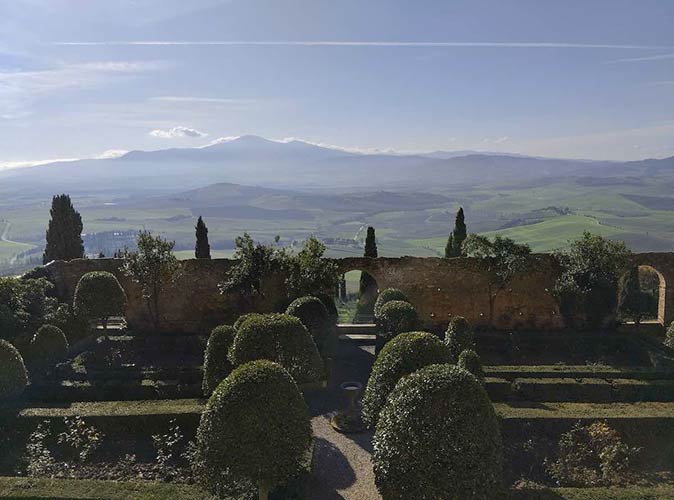
Pienza is a charming Renaissance village located in the beautiful Val d’Orcia, in the province of Siena, Tuscany.
The entire Val d’Orcia is a UNESCO World Heritage Site.
The town is famous for its urban architecture, designed by the Sienese architect Rossellino on commission from Pope Pius II in the 15th century.
Rossellino followed the rules of harmonic geometry in designing the village, making it a place that benefits the body and mind of the inhabitants.
I visited the village with the whole family in January to experience the harmonic architecture firsthand.
The trip was very relaxing. I don’t know if it was because of Pienza’s architecture or the very comfortable beds in the remarkable rooms of Guesthouse Beccofino, or the colors of the countryside.
Many travelers are worried about traveling to Val d’Orcia in winter, thinking it is not worth it. They are wrong. The landscape is so enchanting that it can be enjoyed in any season.
Attractions not to be missed in Pienza include the Duomo of Pienza, the Palazzo Piccolomini, the Borgia Palace, and the Church of San Francesco.
Pienza is also known for its pecorino cheese, which you can buy at the many local food shops located in the town’s historic center.
In addition, every year in September there is the Fiera del Cacio, a festival dedicated to cheese that attracts visitors from all over the world.
Tuscan ham “prosciutto crudo” is one of the most prized qualities of ham In Italy. Try both the cheese and the ham by ordering a tagliere at the bistro Baccano Il Panino Toscano.
A few kilometers from Pienza you will also find the famous Vitaleta Chapel, one of the most photographed spots in Tuscany.
7. Spello
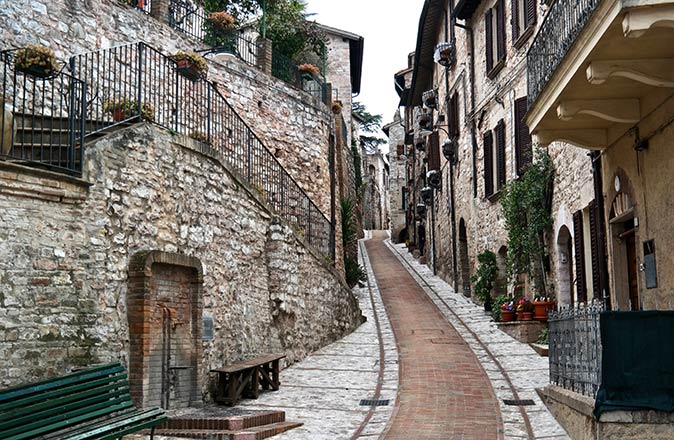
Spello is a beautiful medieval village located in Umbria, in the province of Perugia.
Spello’s historic center is very charming with the stone alleys and medieval-style houses with decorated portals, flowered balconies, and frescoes.
Speaking of flowers, the Infiorata di Spello festival has made Spello one of the most popular villages in Umbria.
During this festival at the beginning of June, the streets of Spello are covered with intricate and colorful designs made entirely of flower petals.
It’s the most anticipated time of the year in Spello.
This festival keeps the community together, creates identity, and keeps locals busy for months. Just imagine how much work must go into collecting many thousands of flower petals from the mountains near the village, storing the petals, and creating the “paintings.”
The infiorata is definitely what makes Spello stand out from so many other Italian villages.
As for historical landmarks, the Church of Santa Maria Maggiore in Spello is one of the oldest churches in Umbria, dating back to the 9th century. The interior of the church houses stunning frescoes, including one by Pinturicchio. Outside of the church you find a lovely garden with arches.
Another attraction in Spello is the Porta Venere, a well-preserved ancient Roman gate located at the entrance to the old town. From here you can enjoy a panoramic view of the Umbrian countryside.
8. Gradara
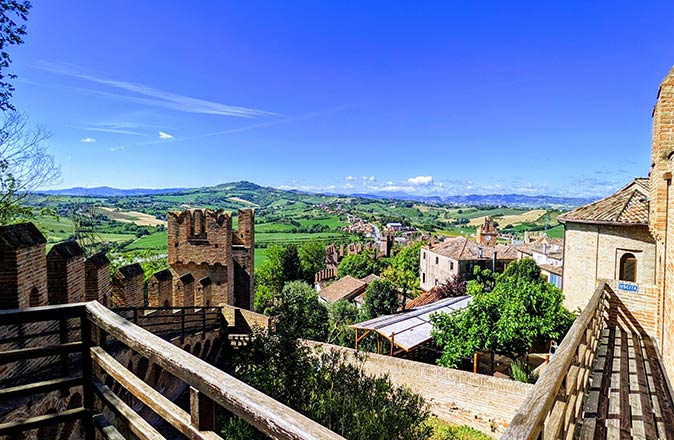
Gradara is a beautiful Italian village located in the province of Pesaro e Urbino in the Marche region, near the fantastic beaches of the Conero Riviera.
The town’s main attraction is the Gradara Castle.
Imposing and well-preserved, the castle was built in the 12th century and is known for being the site of the famous love affair between Paolo and Francesca, described by Dante in the Divine Comedy.
The love between the two young lovers ended tragically, and Dante places them in the fifth canticle of the Inferno, dedicated to lustful people who died for love.
I won’t tell you more about this story. Gradara is so enchanting and this area in the Marche region is worth a visit. Therefore, I recommend that you visit Gradara Castle to learn about this love story yourself, which we Italians study in school.
The historic center of Gradara, surrounded by medieval walls, features narrow stone streets, Romanesque and Gothic-style houses, and a beautiful central piazza.
A visit to the Church of St. John the Baptist, away from the tourists’ track, is not to be missed. This small church preserves a crucifix carved in wood that is said to be miraculous.
Looking at the statue from three different perspectives reveals three different expressions of the dying Christ.
The village of Gradara also offers the opportunity to taste the typical dishes of Marche cuisine, such as tagliatelle with rabbit ragout, fish broth, and fossa cheese.
Lastly, the village is famous for its wine production, including Rosso Conero and Verdicchio.
9. Triora
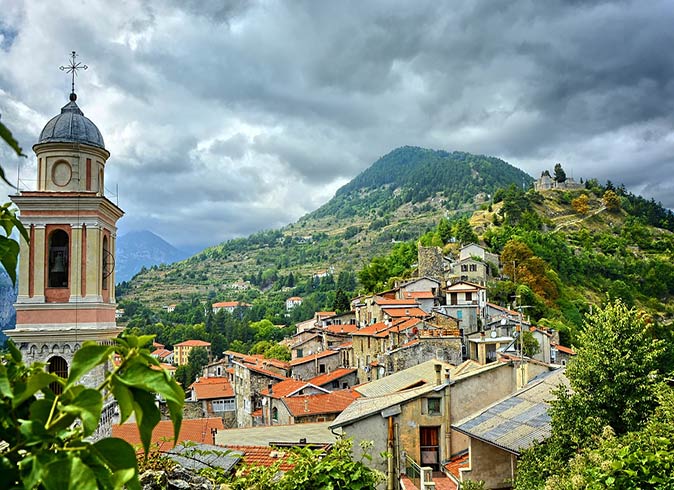
Trioria is a small town located in the heart of the Ligurian Alps.
The town features narrow stone streets, slate houses, the Church of San Bernardino situated on the main piazza, and a charming castle.
Triora is famous for the story of the witch hunt, which dates back to the years 1587 and 1588. At that time, the town was affected by a severe famine. The people’s despair turned into hatred toward some 20 women who were considered witches and were thought guilty of causing the famine with their magical arts.
Today in the village you can visit the Ethnographic and Witchcraft museum, where you can learn about the history and traditions related to this ancient cult.
Because the village is located in the mountains, there are plenty of hiking trails and spots to have a relaxing picnic in unspoiled nature.
If you enjoy trying typical dishes from the area definitely do not miss the delicacies made from lamb and goat meat, local cheeses, mushrooms, and the fantastic herbs that grow in the local forests.
10. Morano Calabro
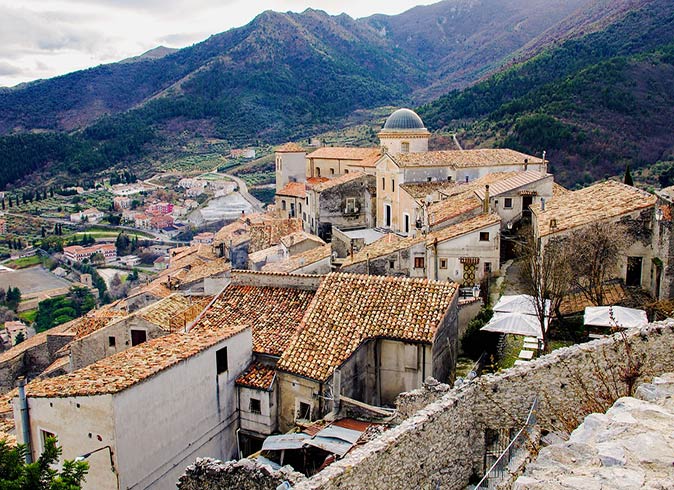
Morano Calabro is a small town located in inner Calabria. It is a typical Italian hilltop town characterized by a multitude of small houses and narrow alleys.
Among the attractions to visit in this town is the Norman-Swabian Castle, the most important historical landmark in the area.
The castle is a mighty fortress dating back to the 11th century, featuring a series of defensive walls, towers, and bastions. It is accessible to visitors, and from here, you can enjoy panoramic views of the surrounding valley.
Another place to visit in the village is the Museum of Agriculture and Pastoral Farming, a place that tells the story of daily life and traditions of the village and the Calabria region.
The museum houses a large collection of tools used in the past to work the land, make bread and wine, keep animals, and perform other trades typical of the region. If you are curious about Calabrian traditions and history, the museum is definitely worth a visit.
11. Montalbano Elicona
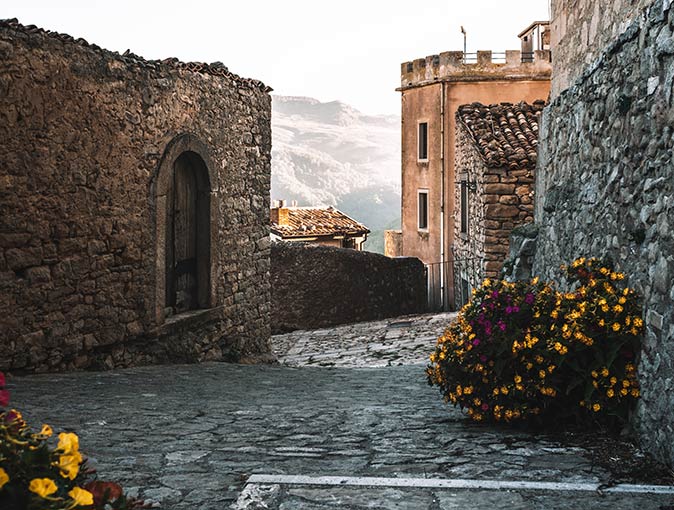
Montalbano Elicona is a small medieval village located in the province of Messina, Sicily.
The steep lanes featuring old stone houses arranged in a semicircle lead to the Montalbano Castle, built in the 13th century, and the many churches.
Make sure to take a look inside the Cathedral of Santa Maria Assunta.
The town lies at the foot of the Malabotta Forest Nature Reserve where you can spend a day walking and spotting the animals grazing in the fields.
Montalbano Elicona, just like Morano Calabro, stands on a hill, and from its summit you have a splendid view all the way toward the coast.
The local cuisine is renowned for its dishes of porcini mushrooms, sheep’s cheese, and wine produced from local grapes.
12. Camogli
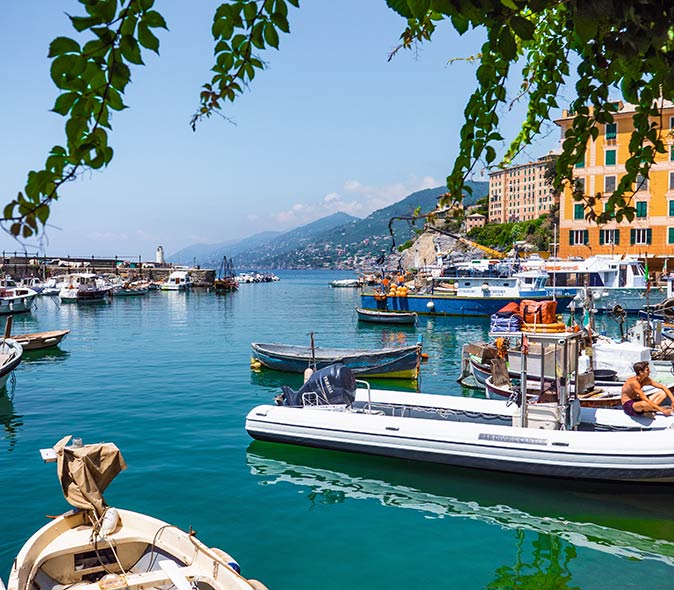
Camogli is a charming fishing village located on the Riviera di Levante in Liguria.
The village is characterized by colorful houses overlooking the sea, a picturesque small port, and a long pebble beach.
The Church of Santa Maria Assunta, with its black-and-white striped bell tower, dominates the village’s central square.
A medieval fortress located on the hillside towers over the village: this is the Castel Dragone. The structure was built in the 12th century to defend against pirate raids and today hosts cultural events and art exhibitions. And because of its location it offers spectacular views of Camogli Bay and Paradise Gulf.
Camogli is famous for its fresh seafood cuisine and the Sagra del Pesce, an annual festival in which the town’s fishermen prepare and serve freshly caught fish. In 2027, the festival will take place from May 7th until May 9th.
13. Castelbuono
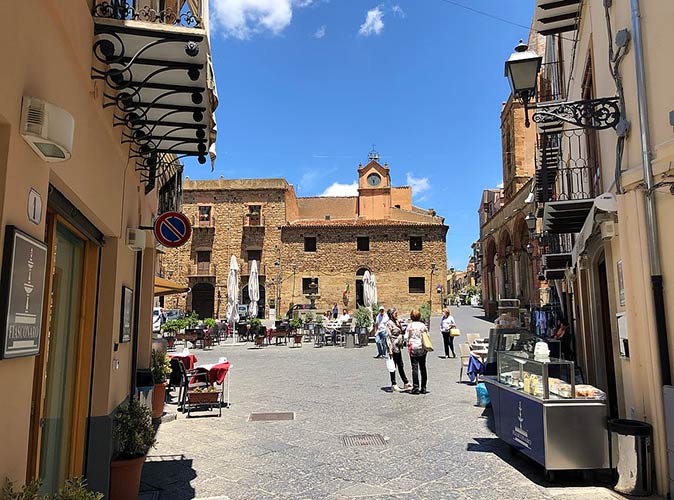
Castelbuono is a charming Italian village located in the northern part of Sicily, on the slopes of the Madonie Mountains.
The town is known for its imposing Castelbuono Castle, dating back to the 14th century. The architecture and interiors of the castle are perfectly preserved.
The castle houses the Castelbuono Civic Museum, where a vast collection of historical and artistic artifacts is on display, including miniature manuscripts from the 14th and 15th centuries, frescoes and canvases by Sicilian masters of the 17th and 18th centuries, ceramics, ancient porcelain, and medieval weapons and tools.
The historic center of Castelbuono is characterized by cobblestone lanes, aristocratic palaces, ancient churches, and artisan workshops.
Among the must-see attractions in Castelbuono are the Mother Church and the Cloister of San Francesco located in the main piazza.
The town is also known for its excellent local cuisine, based on typical products such as porcini mushrooms, cheeses, cold cuts, and fine wines.
Among the typical Castelbuono dishes you should try are sfincione, a soft flatbread topped with onions, tomatoes, and caciocavallo cheese, pane cunzato, a roll filled with cherry tomatoes, anchovies, and primo sale cheese, and almond pastries.
14. Cervo

Cervo is a picturesque village located on the Riviera dei Fiori, in the province of Imperia, Liguria.
The small town, perched on a hill overlooking the sea, features ancient buildings and small piazzas with panoramic views of the Mediterranean.
The streets of the historic center, dotted with artisan workshops and souvenir shops, invite a leisurely stroll amid traditional Ligurian scents and flavors.
Some places not to miss in Cervo are the Church of St. John the Baptist, one of the masterpieces of Ligurian Baroque, the Clavesana Castle, now a venue for exhibitions and cultural events, and the Sanctuary of the Madonna of the Angels, located on the hillside outside of the town, reachable on foot via a scenic path.
Cervo is also known for its music festival, held every summer attracting artists and visitors from all over the world.
Local gastronomic specialties include seafood, pesto sauce, and Vermentino white wine.
15. Sperlinga
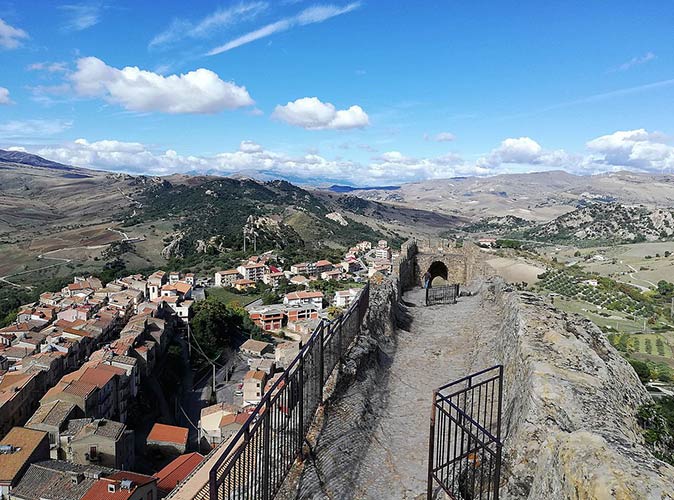
Sperlinga is a charming medieval village located in the province of Enna, in central Sicily.
This ancient village is located on a rocky hill, surrounded by forests and rocks.
With less than 1,000 inhabitants and not too close to the coast, Sperlinga is a small town to retreat to if you love calm and nature.
The village is famous for its magnificent 13th-century castle, located on the top of the hill. Sperlinga Castle, also known as Rocca di Sperlinga, is one of the best examples of medieval military architecture in Sicily.
Inside the castle you can admire a series of rooms, towers, corridors, and courtyards, which tell the story of the fortification and defense of the village.
Underneath the castle you can visit the famous “Cunicolo di Sperlinga,” an ancient underground tunnel used by locals during wars to reach the outside of the walls without being seen by enemies.
The village is famous for the many caves in the surrounding area, including the Lion’s Cave, the Defense Cave, and the Shepherds’ Cave.
These caves were used in the past as shelters and rock dwellings and are an interesting record of the life of local people in medieval times.
16. Montefalco
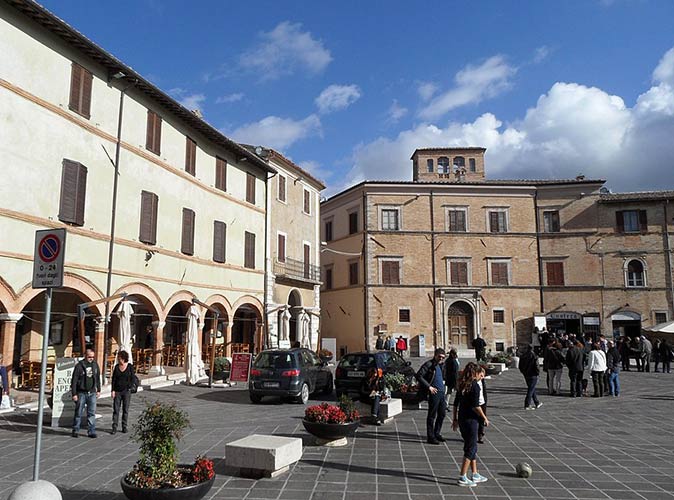
Montefalco is a village located in Umbria, known for its historic center surrounded by medieval walls and for the production of the prized Sagrantino wine.
This village features many landmarks, including the Church of Sant’Agostino, the beautiful town hall, and the Civic Museum of San Francesco.
Montefalco is also a great place for nature lovers, who can enjoy beautiful walks through the area’s vineyards and olive groves.
In addition, Montefalco’s strategic location makes it a good base for visiting other Umbrian towns of tourist interest, such as Assisi, Spoleto, Bevagna, and Todi.
17. Castelmezzano
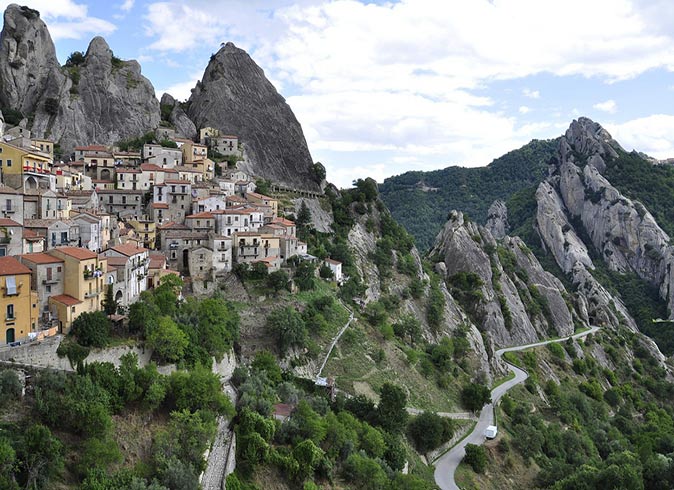
Castelmezzano is a small village located in Basilicata, known for its spectacular rock formations, the Lucanian Dolomites.
The large rocks behind the settlement frame the village and make the landscape unique and even a bit bizarre.
The locals have given some of the rock formations names, such as The Owl, the Great Mother, the Golden Eagle, the Anvil, and the Lion’s Mouth.
The first thing to do in Castelmezzano is to visit the main square with the Church of Santa Maria dell’Olmo, the cafes where time has stood still, and the lookout point.
If you love to walk, you can venture out to discover the ruins of Castelmezzano Castle and the Norman staircase carved into the rock at the most scenic point.
The town is also famous for adventurous activities, particularly the Angel’s Flight, a vertical zip-line starting at the top of Mount of the Cross, and arriving in the town of Pietrapertosa.
Castelmezzano is also an excellent starting point for excursions in the surrounding area, including visits to the Monticchio lakes, the city of Matera and other places in Basilicata.
18. Borghetto sul Mincio
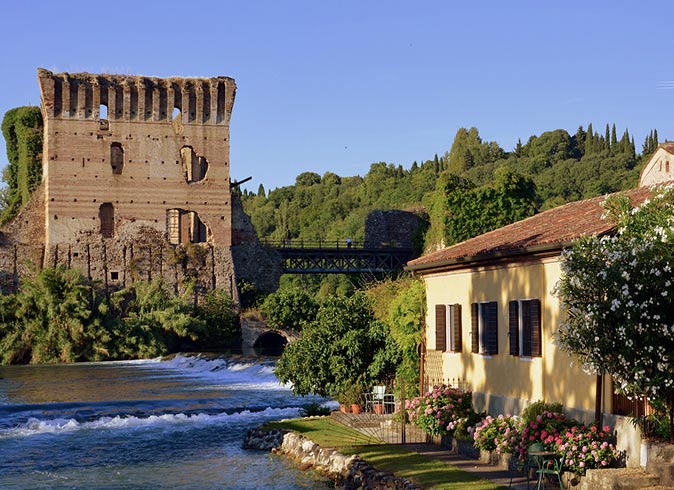
Borghetto sul Mincio, one of the most beautiful towns in northern Italy, is located in the province of Verona.
Borghetto features stone houses, ancient bridges, mills, and canals.
The historic center runs along the banks of the Mincio River and is crossed by the Ponte Visconteo, an ancient stone bridge that offers a lovely view of the village.
The presence of the river makes Borghetto Sul Mincio a fascinating and fairy-tale place.
Among the main attractions of this enchanting town are the Borghetto Mill, an ancient water mill still in operation, and the Scaliger Castle of Valeggio sul Mincio, a medieval fortification located on the hill overlooking the village.
The village is also famous for its restaurants, where you can enjoy typical Veronese and Mantuan cuisine, including the famous tortellini di Valeggio.
In addition, the village is an ideal starting point for excursions into the surrounding countryside and for visiting other medieval villages in the area, such as Valeggio sul Mincio and Castellaro Lagusello.
19. Positano
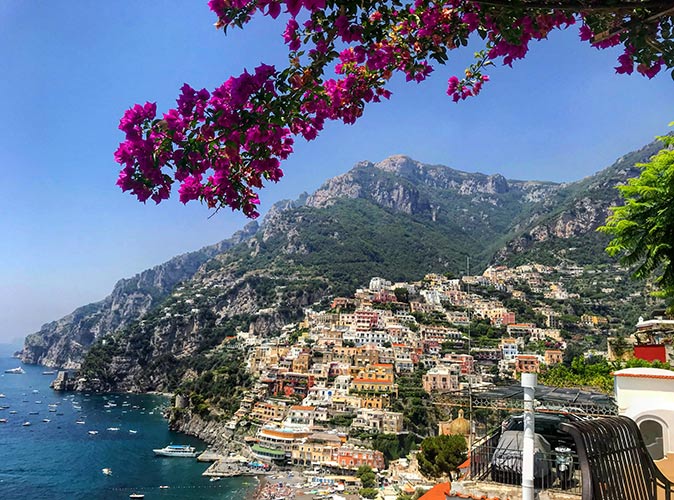
Positano is a beautiful coastal town located in southern Italy, on the Amalfi Coast.
It is often listed as one of the best small towns in Italy and attracts visitors from all over the world.
The town is known for its stunning beauty, with colorful houses perched on steep cliffs overlooking the clear blue waters of the Mediterranean. Visitors can enjoy panoramic views of the town from various vantage points, including the beach, the harbor, and the narrow streets.
Positano has several beaches, including the main beach, Spiaggia Grande, which is a popular spot for sunbathing and swimming. The smaller Fornillo beach, accessible by a scenic footpath, is another great option for those looking for a quieter beach experience.
You can explore the nearby cliffs and mountains on foot or by bike, or take a boat tour of the coastline.
Positano is renowned for its quality restaurants serving traditional Italian dishes made with fresh, local ingredients. The area is home to several wineries, producing some of Italy’s best wines.
Positano has a rich history dating back to Roman times, and visitors can explore the town’s ancient ruins and museums. The town also has a thriving arts scene, with many local artists showcasing their work in galleries and studios.
20. San Gimignano
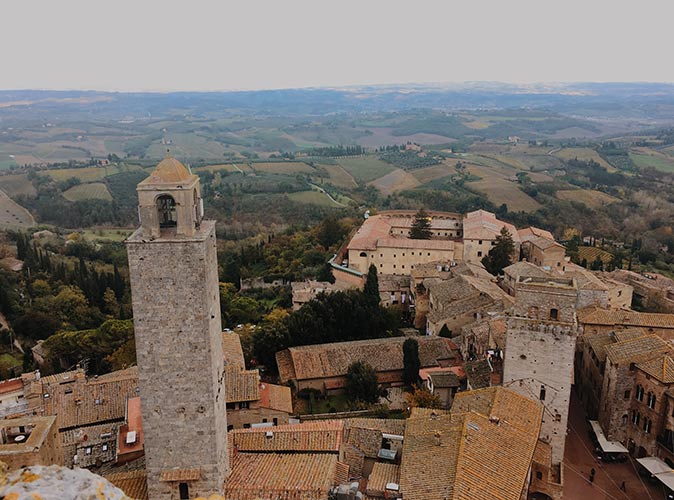
San Gimignano is a medieval hill town in Tuscany known for its well-preserved tower houses and stunning views of the surrounding countryside.
This beautiful town offers a unique combination of history, culture, and natural beauty.
The historic center of San Gimignano is a UNESCO World Heritage Site. The town has 14 towers, which were built in the 13th and 14th centuries as a symbol of power and wealth. Today, these towers are some of the town’s most iconic landmarks and provide stunning views of the surrounding countryside.
Visit the Civic Museum, which houses an impressive collection of Renaissance paintings and sculptures, or the Archaeological Museum, which features artifacts from the Etruscan and Roman periods.
San Gimignano is surrounded by rolling hills and picturesque vineyards, making it a perfect destination for nature lovers. You can take a walk along the town’s walls to enjoy the stunning views or explore the nearby countryside on foot, by bike or on horseback.
Tuscany is renowned for its delicious cuisine and San Gimignano is no exception. Go to one of the many restaurants and wine bars in town to enjoy local specialties such as pici pasta, ribollita soup, and the famous Chianti wine.
Throughout the year, San Gimignano hosts various festivals and events that showcase the town’s traditions and culture. The most popular events are the Medieval Festival in June, the Vernaccia di San Gimignano Wine Festival in September, and the Christmas market in December.
21. Cortina d’Ampezzo
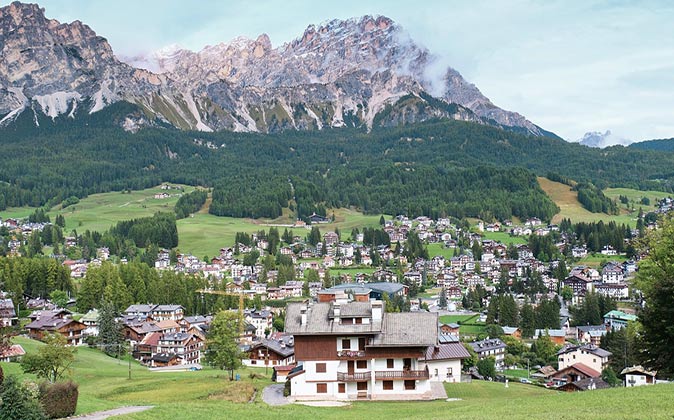
If you love nature, outdoor activities, culture, and food, Cortina d’Ampezzo is a beautiful small town to visit.
Cortina d’Ampezzo is located in the heart of the Dolomite Mountains, in the Veneto region of northern Italy.
The Dolomite Mountains surrounding Cortina d’Ampezzo are a UNESCO World Heritage Site and are known for their stunning natural beauty, including towering peaks, jagged ridges, and emerald green valleys. The town itself is also picturesque, with quaint streets and traditional Tyrolean architecture.
Cortina d’Ampezzo is a popular destination for outdoor enthusiasts, offering a wide range of activities throughout the year, including skiing, snowboarding, snowshoeing, ice skating, hiking, mountain biking, and rock climbing.
Cortina d’Ampezzo is one of the most famous ski resorts in the world, with over 120 km of ski runs and 38 lifts. It has hosted the Winter Olympics and numerous international ski competitions.
Cortina d’Ampezzo has a rich cultural heritage, with a blend of Italian, Austrian, and Ladin traditions. The town has several museums, including the Ethnographic Museum and the Mario Rimoldi Modern Art Museum.
Cortina d’Ampezzo has a vibrant shopping scene, with a variety of luxury boutiques and artisanal shops selling local crafts and souvenirs. There are also numerous restaurants serving delicious Italian and Tyrolean cuisine, as well as a vibrant nightlife scene.
22. Alberobello

Alberobello is a small town located in the Puglia region of southern Italy.
The town is known for its unique and charming trulli houses. These small, white, cone-shaped structures are made of local limestone and have been standing in the town for centuries.
Alberobello’s trulli houses were declared a UNESCO World Heritage Site in 1996, and are a major draw for tourists from around the world.
Walk around the town and explore the different neighborhoods, each with its own cluster of trulli houses, and learn about the history and culture of this unique and charming region of Italy.
Tip: several of the trulli houses have been converted into Airbnbs. For a truly unique experience you can book a stay in one of these traditional houses, both inside Alberobello or in the countryside around the town.
Besides the trulli houses, Alberobello is also home to several historical and cultural attractions, including the Church of Saint Anthony, the Casa Pezzolla Museum, and the Trullo Sovrano, which is the largest and oldest trullo in Alberobello.
Overall, Alberobello offers a glimpse into a type of traditional architecture that is unique to this part of Italy.
Alberobello does receive a lot of visitors and can feel very touristy, especially in high season.
Also Read: Where to Stay in Puglia and Things to Know Before Visiting Puglia
23. Portofino
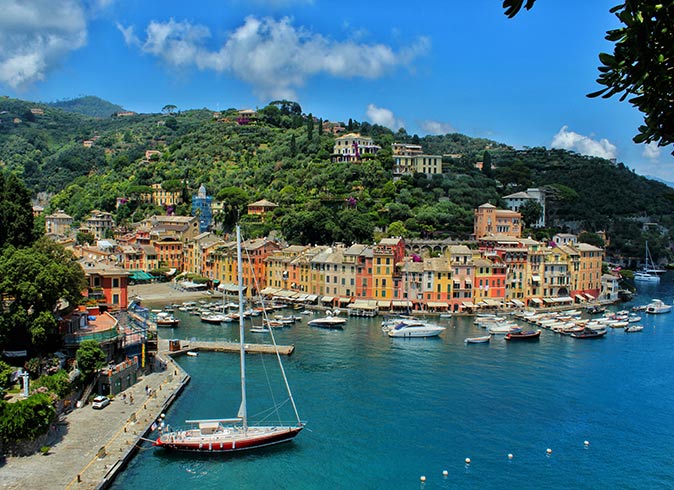
Portofino is a small, picturesque fishing village located on the Italian Riviera, known for its colorful houses, stunning harbor, and beautiful natural scenery.
It’s a charming and culturally rich town, with a long history of maritime activity and a vibrant local culture.
Wander around the narrow streets of the town center, browse local shops and boutiques, and explore historic sites like the Castello Brown, a hilltop fortress that offers panoramic views of the harbor.
Portofino is home to a variety of excellent restaurants, serving fresh seafood, regional specialties, and Italian classics.
Enjoy a meal on a sunny terrace overlooking the harbor, or try your hand at cooking traditional Ligurian dishes at a local cooking class.
The small town is surrounded by hills covered in olive groves and fragrant Mediterranean vegetation.
You can hike or take a boat ride to explore the rugged coastline, visit nearby nature reserves, and enjoy the breathtaking views of the sea.
Portofino is also a popular destination among the rich and famous, who come to enjoy the luxurious lifestyle, high-end shopping, and glamorous events such as the annual Portofino Yacht Club Gala.
24. Vernazza (Cinque Terre)
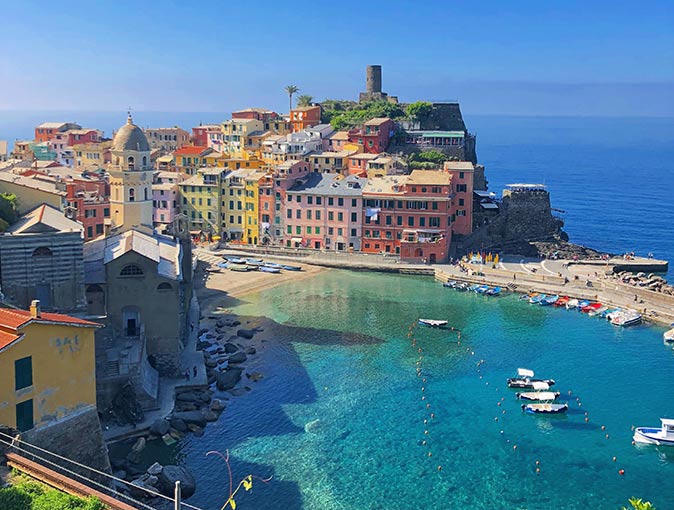
This small fishing village is part of the Cinque Terre and is known for its colorful houses and beautiful harbor.
All five of the towns in Cinque Terre – Monterosso al Mare, Vernazza, Corniglia, Manarola, and Riomaggiore – are beautiful in their unique ways, but many people consider Vernazza to be the most beautiful of them all.
Vernazza is a small fishing village with a picturesque harbor, colorful houses, and a medieval castle perched on top of a hill overlooking the town. Its winding streets and narrow alleys are filled with charming shops, cafes, and restaurants, and it has a lively atmosphere that makes it a popular spot for tourists.
You can hike to the nearby villages, swim in the crystal-clear waters, or simply relax and take in the stunning views of the Ligurian Sea.
25. Castell’Arquato

Castell’Arquato is a beautiful medieval town located in the Emilia-Romagna region of Italy.
Castell’Arquato has a rich history dating back to the 8th century, and the town’s beautiful architecture and landmarks reflect this.
The town is home to several medieval buildings, including the impressive Visconti Castle, which dates back to the 14th century. The town’s beautiful Romanesque cathedral, the Collegiate Church of Santa Maria Assunta, is also a must-see.
In addition to its historical landmarks, Castell’Arquato is also known for its beautiful natural surroundings. The town is situated on a hill, offering stunning views of the surrounding countryside.
Take a leisurely stroll through the town’s narrow streets and alleys, which are lined with beautiful stone buildings and charming shops and cafes.
If you love sampling local food, Castell’Arquato is also a great town to visit. The town is located in the heart of the Emilia-Romagna region, which is famous for its food and wine. Cured meats, fresh pasta, and Parmesan cheese are popular local delicacies, paired with excellent local wines.
Castell’Arquato is a beautiful and historic town that lets you experience the rich culture and natural beauty of the Emilia-Romagna region.
Map of the Most Beautiful Small Towns & Villages in Italy
The Best Small Towns in Italy to Visit – Final Words
When it comes to picturesque small towns and villages, Italy really has an edge.
There are thousands of them, from north to south Italy, and since tourism is the main resource of these places, they know how to look their best.
As opposed to certain Italian cities, small Italian villages are unlikely to disappoint, especially if you enjoy the slower pace of small towns, and trying the best that authentic Italian cuisine has to offer.
When planning a visit to any small Italian village, the one thing to consider is the time of year you’re visiting.
Between mid-November and late February, excluding the Christmas season, the more off-the-beaten-path villages may have limited services during weekdays. For example, you may find museums closed Monday through Thursday. And some restaurants even close for several months.
But, you may enjoy the quiet winter months, without the tourists.
Instead, if you visit in the summer, you will find the towns more lively and you’re likely to come across local festivals, craft markets, music, theater, and outdoor cinemas.
But with that come the summer crowds and higher prices for accommodation.
No matter what time of year you visit these beautiful Italian towns though, I am sure you’ll love them just as much as I do!
A final thing to know about visiting small towns and villages in Italy is that many aren’t easy to reach by public transport.
A few of these towns have a train station and most have some busses connecting them to nearby towns. But, if you really want to explore Italy’s smaller towns, renting a car is the most convenient option.
Also Read:
- 24 Hours in Rome – What to See & Do
- Visiting The Vatican – Things You Need to Know
- What Not to Miss in Milan
- Things to Do in Pavia, Italy
- The Most Beautiful Places to Visit in Sicily
- Visiting Puglia – Popular Questions Answered
Like this article about the best small towns in Italy to visit? Pin it!
