

Are you thinking about sailing in Curacao? Then you’ll hopefully find this sailing guide helpful.
I have to start by saying though that Curaçao is a slightly strange sailing destination.
It’s perfect because it’s outside of the hurricane area but it doesn’t cater to liveaboard sailors well.
There is only one anchorage where you can stay for more than 3 nights (Spanish Water) and the few other legal anchorages require applying for a three-night cruising permit specifying the exact dates you will be anchoring (we all know this type of planning isn’t easy when sailing!).
But, more about the anchorages in Curacao later.
First I want to share some general information about sailing in Curaçao.
Sailing in Curaçao – Useful Things to Know

Sailing Related Things to Know
1. There is an active Facebook group called Curacao Cruisers.
I’d recommend joining this group before you arrive as you can find a lot of useful information here about sailing in Curacao.
2. Unlike most other Caribbean sailing destinations, there is no cruisers net in Curacao.
3. Customs & Immigration are located on opposite ends of Willemstad, and not near an anchorage.
Assuming you are using public transport, clearing in and out can easily take half a day. Customs is located a short walk from the bus stop in Willemstad, but Immigration and the Harbour Master are another 20-minute walk away.
When clearing in you start at Immigration, followed by the Harbour Master where you buy your anchoring permit, and ending at Customs. When clearing out you’ll have to go to Customs and to Immigration and can do that in any order.
4. All crew members have to be present at Immigration when clearing in and clearing out of Curacao.
5. Curaçao uses SailClear. It is not mandatory but creating an arrival notification on SailClear.com before arrival speeds up your clearing in process.
6. Spaanse Water, or Spanish Water in English, is the only anchorage you can stay at for more than three nights.
As briefly mentioned above, you need an anchoring permit in Curaçao if you aren’t staying in a marina. You can get a three-month anchoring permit for Spaanse Water, which can be renewed.
But, for all the other anchorages, which I describe in detail later on in this article, you’ll have to get a separate anchoring permit and these are for three nights per permit.
To obtain an anchoring permit you’ll have to go to the Harbour Master in person. Both the three-month permit for Spaanse Water and the other three-night permits cost NAF 44.35 (around US$ 25) per permit.
For all the three-night permits you have to specify exact dates. If your dates change you will have to go back to the Harbour Master to obtain a new permit.
7. When you sail into Curaçao your first anchorage will be Spanish Water. As you approach the entrance to Spanish Water, contact the Coast Guard on VHF channel 16. They will tell you exactly where they want you to anchor and how to proceed.
8. Curacao Marine is Curacao’s main boatyard with good facilities if you need work done on your boat.
We thought, because it’s located close to Willemstad, that it would be a nice marina to dock the boat for a few days. It’s not that type of marina. It doesn’t really offer facilities for that (think shops, restaurants, etc.) and is located a long walk away from town.
But I’ll describe the marinas in Curaçao in more detail later on.
General Things to Know About Curaçao

1. The Bus app called ABC Curacao is very useful. It shows quite accurately when the next bus will arrive at any bus stop around the island.
And because the bus that goes to Spanish Water only goes about once every hour or even less frequently, it’s very useful to know when the next one will be.
2. There are minibusses as well, which you can flag down and will stop anywhere along their route.
They charge a bit more than the main bus service and don’t run on a fixed schedule.
They can be very infrequent the further away you are from Willemstad. More than once I’ve spent almost an hour waiting for one.
3. I’d recommend renting a car. Buses are infrequent and don’t run at night.
Plus, you will probably spend most of your time in Spanish Water, from which it isn’t easy to get everywhere by public transport (getting to the main hardware store for example).
I’d recommend renting a car for at least a few days to explore the island, and for most of your stay in Curacao if you expect to need a lot of visits to the chandlery, hardware store, and other boat-related services.
4. US Dollars are accepted everywhere.
You might get change back in Guilders but you can always pay in US Dollars, including on the bus.
You can even choose to take out US Dollars from local ATMs instead of Guilders.
5. Most people in Curaçao speak English, but not everyone. And you’ll regularly run into people whose English is limited.
The main languages here are Papiamento and Dutch. Papiamento has a lot of resemblances to Spanish, so if you speak Spanish that can be useful here. Plus there are a lot of people from Latin American countries living here as well.
Anchorages in Curacao
1. Spanish Water / Spaanse Water

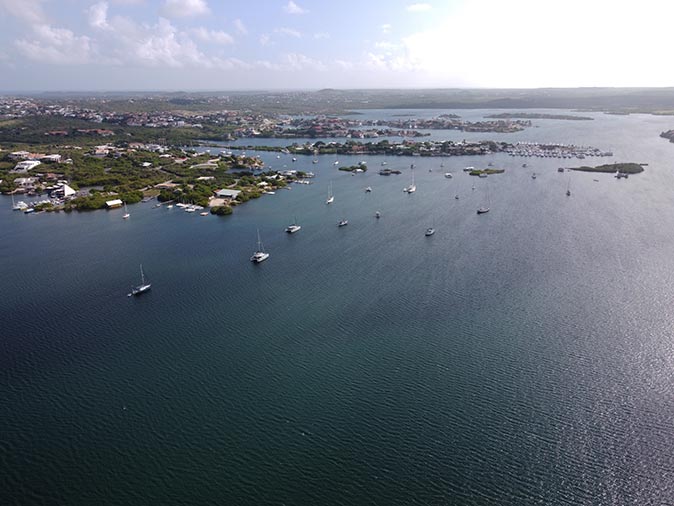
As mentioned above, this is the only anchorage in Curacao you are allowed to stay long-term.
The entrance to Spanish Water is long and slightly narrow with some rocks and shallow areas to avoid. Most navigation aids show this clearly but I wouldn’t recommend arriving after dark.
There is a designated quarantine area, which is the first big inlet on your left once you’ve entered Spanish Water. But, just contact the coast guard on VHF channel 16 as you are approaching Spanish Water, and they will tell you exactly where to go and what to do next.
That is, if the coast guard hasn’t contacted you already. They are very active, and very helpful, and will most likely contact you as soon as they see you sailing into Curacao.
The normal anchorage areas take up most of the area you see on the map left of the entrance. But again, contact the coast guard as you arrive and they will explain exactly where you can and cannot anchor.
Spanish Water offers good holding and a very sheltered anchorage. It is a well-protected bay in case a storm would ever make it this far south.
Facilities in and Around Spanish Water

I have to admit, with Spanish Water being the main anchorage in Curaçao, I was a bit surprised by how limited the facilities are that you can reach directly by dinghy.
I’m used to easy access to a chandlery, a supermarket, laundry facilities, and a specialized boat service or two, which is the case in Caribbean sailing destinations such as Grenada, Saint Lucia, St Maarten, and many others.
1. The chandlery is a bus ride away and so are the main shops and supermarkets. But, there is a free bus from Monday to Saturday that takes you to a supermarket and Budget Marine, the main chandlery on the island. Check the above-mentioned Facebook group for current times.
2. There is a good supermarket plus several bars and restaurants by Jan Thiel Beach, which is within walking distance.
3. Brisa do Mar and The Pier are both good restaurants right by Spanish Water and Windsurfing Curacao is located inside Spanish Water. There is a sunken tugboat off Tugboat Beach which makes a great snorkeling site. The fort, Fort Beekenburg, is worth walking to as well.
4. A laundry service, a chandlery, an upholstery company, and several other useful services are all on the bus route (bus 6A). But for the best information about where to get specific boat-related services I recommend posting a question in the Facebook group.
5. The dinghy dock in Spanish Water is located just past the main fuel station (not the one by the Yacht Club, the one on the west side of Spanish Water). It’s a tiny dinghy dock and often crowded.
6. If you are visiting restaurant The Pier you’re allowed to tie up directly by the restaurant.
7. The Yacht Club is a members-only club and does not allow outside guests.
8. Even with a wifi range extender we’ve never been able to pick up any wifi networks while anchored in Spanish Water.
I used a local SIM card from Digicel which worked without issues 99% of the time. But I’ve seen people commenting in the Facebook group about better deals on data through a local guy, so it might be worth looking into that, especially if you think you’ll use a lot of data and are staying in Curaçao for a while.
Also Read: The Best Cafes in Curaçao to Work From & Other Wifi Tips
Final Things to Know About Anchoring in Spanish Water
1. Spaanse Water is a very sociable anchorage. There will always be dozens of other sailboats anchored here, making it easy to meet other sailors.
On Thursday night the local restaurant, The Pier, organizes ‘Cruisers Night’, which is a great way to meet other sailors. Check the Facebook Group for details, and for other events around Spanish Water.
2. There is a speed limit of 5km (less than 3 knots) in Spanish Water but nobody, not even the coast guard, seems to stick to this.
You’ll find local speed boats going past at high speed frequently and if you’re close to the traffic lane that can cause an annoying wake. Plus of course it’s incredibly dangerous, especially at night if you are in your dinghy.
2. Klein Curaçao

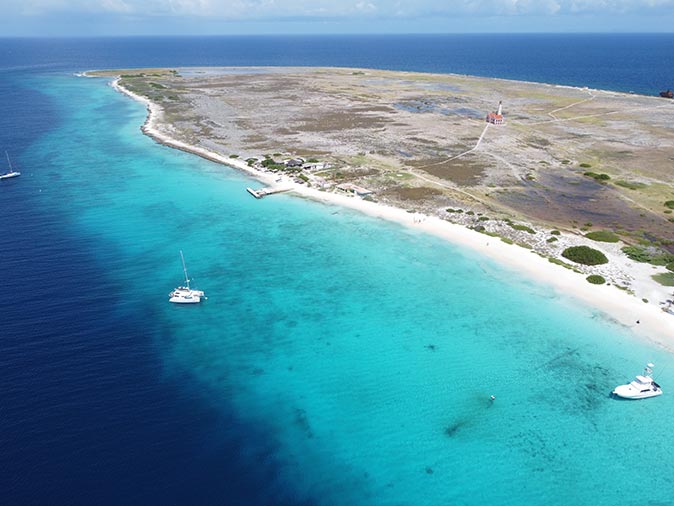
If you only visit one anchorage in Curaçao, then make it Klein Curaçao!
It’s a small island that receives a lot of visitors during the day, but around 4pm most commercial boats have left, and by the time the sun sets it will only be you and at most a handful of other sailboats.
With impressively beautiful blue water and white sand, it’s just a great spot to wake up in!
The snorkeling isn’t as great as I expected because a lot of the coral has died, but you’ll still see all the typical Caribbean reef fish and a turtle if you are lucky.
There are mooring buoys and if there are any available I’d recommend using them. They are in ok condition, but of course, if you can, do swim on them to check them.

If there aren’t any mooring buoys you’ll have to anchor quite close to the beach as it shelves rapidly.
Close to the beach you’ll anchor in sand, in 5 meters (16.5 feet) or less.
Apart from the lighthouse there are a few other structures on the island, including two restaurants set up by two of the companies taking tourists to the island. Both say they only cater to their own guests and not to outside visitors. That also means they close as soon as their boats take off in the afternoon, leaving the island nice and quiet.
There is a nice area by the beach set up for barbecues and bonfires, and plenty of spots to just sit and watch the sunset.
It really feels like a world away from Curaçao!
Sailing to Klein Curaçao is, assuming you are coming from Spanish Water, an upwind sail. I’d therefore recommend trying to sail here in good weather to make it a more pleasant sail.
Also, the anchorage is rolly in any weather, but can get quite uncomfortable in bad weather.
Note: I know we were very lucky, so I’m not making any promises, but we saw both a whale shark and a humpback whale on our sail to Klein Curacao!
3. Piscadera Bay

Piscadera Bay, or Piscaderabaai in Dutch, is a very sheltered anchorage and you’ll most likely have the anchorage to yourself.
But, I don’t see many reasons to anchor here. The water is murky and the scenery is not that interesting.
It does put you close to Sambil, Curaçao’s biggest shopping mall, and Royal Marine is located inside the bay.

Royal Marine is a small marina with haul out facilities. It might be a cheap alternative to Curacao Marine if you need to get your boat out of the water.
Further down in this article I share more information about the different marinas in Curaçao.
Unless you benefit from being in this area or want to use Royal Marine’s services I don’t really see much of a reason to anchor here.
But, if you do end up anchoring here and see something worthwhile that I missed, do let me know!
Note: I’ve heard some bad stories about boats being broken into while left alone at Royal Marine, so that is something to keep in mind if you’d decide to leave your boat here.
4. Santa Martha

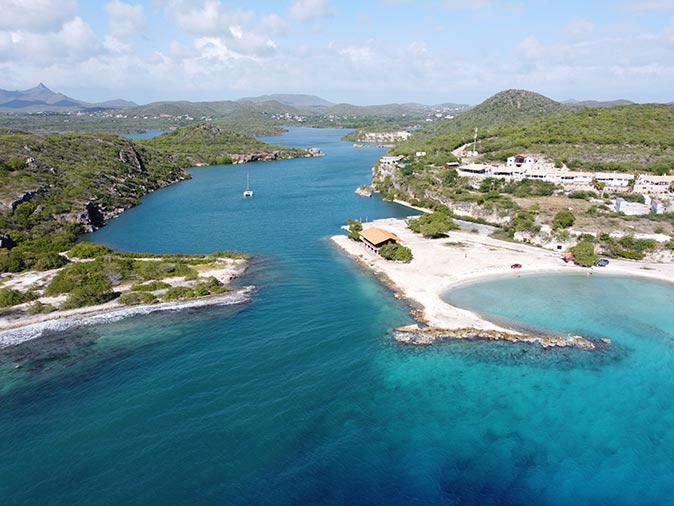
The anchorage at Santa Martha is inside the lagoon.
The entrance to the lagoon is shallow and narrow, which makes it a tricky approach.
The water in the middle of the entrance is only around three meters (10 feet) deep, with shallower patches on both sides. I’d recommend only entering Santa Martha when the weather is good and the sun is out so that you can see the shallow areas at the entrance, as Navionics, and presumably other navigation aids, give limited information.
Holding is very good in mud, and you’ll anchor in around 4-5 meters (13 – 16.5 feet).
The water inside the lagoon is murky but right outside the lagoon, by Santa Martha beach, the water is nice and if you go snorkeling you’ll see a good number of reef fish, and turtles if you are lucky.
It’s a secluded anchorage and you’ll most likely be the only boat anchoring here.
To be honest though, with the tricky entrance, murky water around the boat, and the fact that you have to go out of your way to get an anchor permit, I can’t say I’d really recommend this anchorage.
5. Santa Cruz

This anchorage is lovely! Besides Klein Curaçao this is my favorite anchorage in Curaçao.
Although the anchorage is called Santa Cruz you actually anchor around the corner, off of the small beach called Playa Santu Pretu.
Holding is good, anchoring in sand, and it provides decent shelter. The anchorage starts quite deep (more than 10 meters or 33 feet) but you reach 5 meters (16.5 feet) when you get closer to the beach.
The anchorage is located around a wreck, which makes a really nice snorkeling site.
The only downside is that the wreck isn’t marked with any type of buoy. If the sun is out you can see the wreck through the water if you look closely and you can see the shadow of it in my picture above.
But otherwise there are also almost always other boats anchored here, so just ask them where the wreck is. Because you don’t want to drop your anchor on the wreck!

There is a cave to the south side of the anchorages that’s nice to check out by dinghy. And it’s an easy dinghy ride to Santa Cruz which is a really nice beach. They have picnic tables by the beach, making it a perfect spot for sunset drinks or dinner at the beach.
6. Fuik Bay


Fuik Bay (Fuikbaai in Dutch) is only a short sail along the coast from Spaanse Water. In fact, it’s so close that we went here by dinghy once.
It’s a shallow anchorage, with good shelter, apart from during a southwesterly wind.
You’ll anchor in seagrass and sand, which can make it a bit trickier to get good holding.
The beach at Fuikbaai is only accessible by boat, so I had high expectations of finding a nice, secluded beach. And yes, you will most likely have the beach to yourself but it’s definitely not one of the nice beaches that Curaçao is famous for.
It’s a few small patches of rocky beach surrounded by cacti, rocks, and mangroves.
Snorkeling here isn’t spectacular either since it’s all just seagrass and sand. But, if you are lucky you might see a turtle.
It’s a nice and quiet anchorage though and especially around sunset and sunrise the calm bay, and the view of cacti, rocks and mangroves as the sky changes colors feels very serene.
And, if you go here during the week you’ll most likely have the anchorage to yourself.
On weekends it can get more crowded with local boats and jet skis.
If it wasn’t for the anchorage permit I’d say try this anchorage for a night or two as a nice, quiet, and easy break from Spanish Water. But, having to go all the way to the other side of Willemstad just to get the permit, I’d say use your time to anchor at Santa Cruz and Klein Curaçao first, before you decide to spend your time anchoring here.
Note About the Official Anchorages When Sailing in Curacao
The anchorages listed above are the officially allowed anchorages, which you can visit with an anchoring permit.
Those are the official rules.
But, although you’ll see the coast guard on a regular basis, they seem to pay little attention to what you do on your sailboat.
Therefore you may find people recommending other anchorages or people sailing around Curaçao without the correct cruising permits. How and where you decide to sail around Curaçao is of course up to you!
Marinas in Curacao
Although you’ll find many marinas on Google Maps, as a visiting sailboat there are only really two marinas: Seru Boca Marina and Curacao Marine.
The other marinas you see around Spanish Water don’t cater to sailboats. You could try to contact them though, as I have heard of one or two sailboats using a different dock in Spanish Water.
I contacted the yacht club, who also has a small marina, but they literally said they don’t cater to visiting sailboats…
And then there is Royal Marine in Piscadera Bay, which I described above, but because of the negative reviews I won’t recommend them.
So, here I’ll stick with a description of the two main marinas for sailboats visiting Curacao.
1. Seru Boca Marina
This is a small, quiet marina tucked away in a far corner of Spanish Water.
If you are looking for a quiet place to stay or are planning to leave your boat in Curaçao while you leave the island, this is a perfect marina.
It’s quiet, it’s safe, and seems well maintained.
There aren’t really any facilities here (think shops, laundry service, boat services, or even a bar or restaurant on site) but you are right next to the golf course, there is a bar / restaurant within walking distance, and the rest of Spanish Water you can explore by dinghy.
The main downside for me is that you’re on the far end of Spanish Water, where the bus doesn’t stop. If you rent a car, that’s no problem, but if you rely on public transport to get around, this marina is very remote.
Seru Boca Marina doesn’t have haul-out facilities or a boatyard. For that, you’ll have to go to Curaçao Marine.
2. Curaçao Marine
When I first sailed to Curaçao I thought we might stay in Curaçao Marine for a while, because it looks nice and close to Willemstad, and therefore close to facilities and activities. It’s not that type of marina though.
Curaçao Marine is the place you use if you need to do work on the boat. You can either stay on their dock or haul out, and they have a sizeable boatyard with good facilities.
The staff can help you source pretty much anything you need, but it’s by no means the cheapest marina you’ve ever seen. And, I’ve been told they don’t appreciate it when you use your own contacts to help you get work done on the boat.
There is a small but nice bar a short walk from the marina. The marina is not nearly as close to Willemstad as I thought but you can walk to the city.
Renting a car might still be what you want to do though, especially if you expect several trips to the chandlery and/or hardware store.
Curaçao Marine is often fully booked, so if you need anything done, do plan ahead!
Safety Concerns When Sailing in Curacao
I have to say I have always felt quite safe in Curaçao. And that includes me walking around alone as a woman after dark.
The population in Curaçao is very diverse, meaning that no matter what you look like, you could be someone living on the island and are therefore not automatically seen as a tourist and an easy target.
But, like most Caribbean islands, there are some safety concerns in Curaçao.
Dinghy theft in Spanish Water isn’t uncommon. Reports say this mainly happens at night from the dinghy dock, even though there is a security guard there.
The person we rented our car from while we were anchored in Spanish Water told us to be careful parking it here, as it’s not the safest. Apart from breaking into cars or stealing cars they even sometimes steal car batteries, or so she told us.
One sailor I spoke to mentioned that the car rental agency he tried to use wouldn’t rent to him because he was staying in Spanish Water.
That being said, there is safety in numbers and you’ll always be surrounded by other anchored sailboats in Spanish Water. We’ve left our boat for a night or two to stay on land several times and felt completely safe to do so.
Official reports state that Curaçao has a relatively low crime rate by regional standards, with only rare incidents of violent crime directed at foreign visitors. The main tourist areas are safe, with few instances of street or opportunistic crime.
Crime rates have unfortunately increased significantly in recent years.
And of course, as with any destination you visit, I do recommend you to be careful. Watch your belongings, don’t walk through dark alleys, and lock your dinghy.
Also Read: How to Stay Safe While Traveling
Things to Do in Curacao
1. Explore Willemstad

Willemstad is such a beautiful city!
Its historic center is a UNESCO World Heritage Site filled with colorful houses that are generally very well maintained.
The city also offers a wide range of good cafes and restaurants, plus a good selection of shops.
On top of that, there are several museums, the famous Queen Emma Bridge, and a colorful fruit & vegetable market.
2. Go Scuba Diving
Or snorkeling.
Curaçao is known for its beautiful underwater world and it’s true, there are many good dive and snorkeling sites that are easily accessible.
I did a nice boat dive with Go West Diving.
But, if you have your own dive gear the great thing about Curacao is that you have so many easy shore dives.
Also Read: How to Snorkel – Simpel & Practical Snorkeling Tips
3. Explore Different Beaches

Curacao boasts more than 35 beaches. So you definitely can’t leave the island without checking out a few.
Kleine knip is popular among locals, Piskado Beach is great for spotting turtles, and Kokomo is one of my favorites.
For more information about the main beaches, Curacao.com has a good list here.
Also Read: Why You Shouldn’t Take Shells From the Beach and 15 of the Best Beaches in the World to Visit
4. Enjoy all the Great Restaurant Options
Curacao has so many great restaurants!
If you’d like to just walk around and pick a restaurant at random, then I’d recommend going to Pietermaai in the evening.
Mambo Beach also offers a range of choices, including Hemmingway which I really enjoyed.
If you find yourself closer to Westpunt, then Blue View Sunset Terrace is a good option. Or, a little further south, Landhuis Klein Santa Martha.
But really, there are too many good restaurants to list here. I’d recommend reading some reviews on Google Maps and choosing your favorites.
Other Things to Do in Curacao
One of the great things about Curacao is how many things you can do here.
From a simple evening in a good quality cinema to a cool ATV tour.
Taste the original Curacao liquor at Chobolobo, visit one of Curacao’s many well-kept estates (a ‘landhuis’ in Dutch), or hike up the Christoffel Mountain, the highest point in Curacao.
Visit the tourist board’s website for a more complete list of things to do in Curacao.
Where to Stay in Curacao

Do you want to get off the boat for a few nights? Or do you have friends or family visiting who would like to stay on land?
Then thankfully there is a very wide range of accommodation available in Curaçao.
I’d recommend using Booking.com for anything from hotels to apartment rentals. I found Airbnb a bit limited on the island.
These are some of the places I myself or visiting family and friends enjoyed staying at in Curaçao.
Where to Stay in Curaçao Close to Spaanse Water
1. Casa Amalia
Casa Amalia is a good budget option with comfortable rooms, great air conditioning, friendly staff, and a nice, albeit small, pool area.
It’s less than a 10-minute walk to the dinghy dock in Spanish Water so that made it perfect for my family to stay.
Around the corner from Casa Amalia you can find Bed & Bike, which also offers dorm rooms, as an even more economical option.
2. Papagayo
If you want a bit more luxury and to be right by the beach then Papagayo is a great resort.
It does put you a good 20-minute walk from Spanish Water, but it’s a nice area.
Where to Stay in Curaçao Around Willemstad
I love the fact that Willemstad is such a nice, walkable city with a lot to offer. So, when we first sailed to Curaçao I decided to spend some time in Willemstad to enjoy easy access to cafes to work from, shops, culture, and restaurants.
These are my recommendations for where to stay in Willemstad.
1. San Marco Hotel & Casino
The San Marco Hotel is one of the cheapest hotels in Willemstad but I thought it was great!
The rooms are basic but comfortable, the hotel has a very nice and modern lobby and everything is well maintained.
Plus, the hotel puts you right in the center of Punda, meaning that literally everything in Willemstad is within walking distance.
It can get a little noisy at night since you are in the center of town.
2. Avila Beach Hotel
Pietermaai is the area where people seem to go in the evening. It has a great selection of restaurants and a number of good bars.
Therefore for my second stay in Willemstad I decided to splurge a little and stay at Avila Beach Hotel.
I can highly recommend it!
The resort has nice beaches, great service, a lovely beach bar and restaurant, and a good location to walk to other restaurants at night, or to walk into Willemstad at any time of day.
Note: there are many boutique hotels in Pietermaai as well that come highly recommended such as BijBlauw and Boho Bohemian Boutique Hotel.
Final Thoughts About Sailing in Curacao

I’ve spent several months sailing in Curaçao after previously visiting the island without a boat.
As you can probably tell from this article, I don’t think Curaçao is the best place to visit by boat.
I enjoyed sailing in Grenada a lot more, and Saint Lucia and St Maarten also cater to cruisers a lot better. The BVI and Saint Vincent & the Grenadines are even better sailing destinations.
So, although I wouldn’t recommend Curaçao as the ultimate cruising destination, it does serve some purposes:
1. It’s outside of the Caribbean hurricane belt.
2. It’s easier to get parts shipped here from the USA or Europe than on many other Caribbean islands.
3. Flights to Europe (most notably The Netherlands) are relatively cheap, outside of high season.
And, even though sailing in Curaçao might not be perfect, the island does have enough to offer to keep you entertained for a while.
Willemstad is quite possibly my favorite capital city of all the smaller Caribbean Islands.
Supermarkets here are well stocked and not too expensive to Caribbean standards, locals are friendly and easy to strike up a conversation with and the cruisers community in Spanish Water is welcoming and lively.
So, if you do have to sit out hurricane season somewhere, now you have an idea of what sailing in Curaçao will be like!
And, definitely combine it with a visit to Bonaire if you love scuba diving!
Also Read:
- Sailing in the Caribbean – The Best Places & Other Things to Know
- An Online Sailing Guide for Grenada
- Sailing in Saint Lucia – Anchorages, Sailing Tips and More
- Anchoring in Mullet Bay, Sint Maarten
- Sailing Across the Atlantic – My Experiences
- Sailing in the Azores – Practical Tips & Things to Know
Like this article about sailing in Curaçao? Pin it!

This online Curaçao sailing guide contains affiliate links. I may receive a commission for purchases made through these links, at no additional cost to you.
Absolutely fascinating! Tying up at The Pier restaurant and then walking in to have a meal sounds frightfully chi-chi! So, because of the potential car crime, it sounds like your catamaran not only needs a dinghy, but also a quad bike!
Haha yes, a quad bike would be great fun to have!! But I might have to settle for a folding bicycle 😉